Handling Spammers
There is another way that should not be overlooked to help you mitigate the spam and scam ads on Craigslist. You can clear all your cookies from Craigslist, and send them a contact message at this (https://sfbay.Craigslist.org/contact) page. You’re going to need the post ID of the ads to drop into that form. Once Craigslist determines that your report is valid, they soft-block that poster.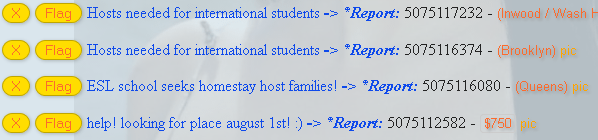
All of a sudden, all their ads come down within minutes of posting. We have included a report link and added the post ID into the title of each post. Now you don’t need to go digging for it or even open the ad to report these spammers, and have Craigslist soft-block their PVA.
Just click the handy report link, and copy the post ID# (the black number in the photo) into the form that pops up and report any ad you disagree with. This will not just affect the specific ad, it will ruin their PVA (Phone verified Account).
Do not contact them from an IP address that you used to send 45 million flags from. You can either go to a coffee shop or change your ip address with a software like HMA (which is free to try and half price) and make sure you are not logged in to a spammy account when you make your Craigslist report, because they look at you as well, to see if you’re just trying to eliminate the competition. If they think you are messing with them, and just another spammer wasting their time and using social engineering tactics with them, they will reinforce your competitor, and soft-block you!
Once the PVA has been reported and soft-blocked, you can easily go in for the kill with your flagger.
As any online community out there, CL wants you to obey certain rules. Those are mainly listed in CL’s TOU that you agreed to when you were creating your account. That means if you don’t learn the TOU, your account might be suspended, or worse your IP address will become soft-blocked from just one report. Posting too many ads per day, posting in different locations and posting in different categories are the most common mistakes that amateur users make.
Unless you have access to dozens of cell phone and land line numbers and you don’t appreciate your CL account, don’t start posting on CL before reading our Posting section. We teach you everything you need to know in order to make sure your PVA has a long prosperous life span.
This document below is directly from Craigslist, some of you have not read it. You should, it gives you an idea of how others are using and misusing the Craigslist website. Everything plays into how you will present yourself on Craigslist. You don’t want to design an ad or campaign that is similar to something Craigslist is warning people to keep away from.
Avoiding Scams
Deal locally, face-to-face —follow this one rule and avoid 99% of scam attempts.
- Do not extend payment to anyone you have not met in person.
- Beware offers involving shipping – deal with locals you can meet in person.
- Never wire funds (e.g. Western Union) – anyone who asks you to is a scammer.
- Don’t accept cashier/certified checks or money orders – banks cash fakes, then hold you responsible.
- Transactions are between users only, no third party provides a “guarantee”.
- Never give out financial info (bank account, social security, paypal account, etc).
- Do not rent or purchase sight-unseen—that amazing “deal” may not exist.
- Refuse background/credit checks until you have met landlord/employer in person.
Who should I notify about fraud or scam attempts?
United States
- Internet Fraud Complaint Center
- FTC Video: How to report scams to the FTC
- FTC complaint form and hotline: 877-FTC-HELP (877-382-4357)
- Consumer Sentinel/Military (for armed service members and families)
- SIIA Software and Content Piracy reporting
- (Ohio only) Ohio Attorney General Consumer Complaints
Canada
- Canadian Anti-Fraud Centre or 888-495-8501 (toll-free)
- Royal Canadian Mounted Police (RCMP)
If you are defrauded by someone you met in person, contact your local police department.
If you suspect that a Craigslist post may be connected to a scam, please send us the details (https://sfbay.Craigslist.org/contact).
Recognizing scams
Most scams attempts involve one or more of the following:
- Email or text from someone that is not local to your area.
- Vague initial inquiry, e.g. asking about “the item.” Poor grammar/spelling.
- Western Union, Money Gram, cashier check, money order, paypal, shipping, escrow service, or a “guarantee.”
- Inability or refusal to meet face-to-face to complete the transaction.
Examples of Scams
1. Someone claims your transaction is guaranteed, that a buyer/seller is officially certified, OR that a third party of any kind will handle or provide protection for a payment:
- These claims are fraudulent, as transactions are between users only.
- The scammer will often send an official looking (but fake) email that appears to come from Craigslist or another third party, offering a guarantee, certifying a seller, or pretending to handle payments.
2. Distant person offers a genuine-looking (but fake) cashier’s check:
- You receive an email or text (examples below) offering to buy your item, pay for your services in advance, or rent your apartment, sight unseen and without meeting you in person.
- A cashier’s check is offered for your sale item as a deposit for an apartment or for your services.
- Value of cashier’s check often far exceeds your item—scammer offers to “trust” you, and asks you to wire the balance via money transfer service.
- Banks will cash fake checks AND THEN HOLD YOU RESPONSIBLE WHEN THE CHECK FAILS TO CLEAR, sometimes including criminal prosecution.
- Scams often pretend to involve a 3rd party (shipping agent, business associate, etc.).
3. Someone requests wire service payment via Western Union or MoneyGram:
- Deal often seems too good to be true, price is too low, or rent is below market, etc.
- Scam “bait” items include apartments, laptops, TVs, cell phones, tickets, other high value items.
- Scammer may (falsely) claim a confirmation code from you is needed before he can withdraw your money.
- Common countries currently include: Nigeria, Romania, UK, Netherlands—but could be anywhere.
- Rental may be local, but owner is “travelling” or “relocating” and needs you to wire money abroad.
- Scammer may pretend to be unable to speak by phone (scammers prefer to operate by text/email).
4. Distant person offers to send you a cashier’s check or money order and then have you wire money:
- This is ALWAYS a scam in our experience—the cashier’s check is FAKE.
- Sometimes accompanies an offer of merchandise, sometimes not.
- Scammer often asks for your name, address, etc. for printing on the fake check.
- Deal often seems too good to be true.
5. Distant seller suggests use of an online escrow service:
- Most online escrow sites are FRAUDULENT and operated by scammers.
- For more info, do a google search on “fake escrow” or “escrow fraud.”
6. Distant seller asks for a partial payment upfront, after which they will ship goods:
- He says he trusts you with the partial payment.
- He may say he has already shipped the goods.
- Deal often sounds too good to be true.
7. Foreign company offers you a job receiving payments from customers, then wiring funds:
- Foreign company may claim it is unable to receive payments from its customers directly.
- You are typically offered a percentage of payments received.
- This kind of “position” may be posted as a job, or offered to you via email.